
In His Own Words: Raoul Middleman
[ad_1]
* * *
There’s a thread in the late work of painters like Rembrandt and Velazquez that has to do with the precarious way you hold sensation. In other words, you don’t possess things, you just touch them. You can’t take possession of sensation. You can’t really take possession of anything; it’s a transient encounter. And that’s what life is. You get that especially in Rembrandt’s late self-portraits, that very human moment—it holds. Nobody could make things that you can hold better than Rembrandt. He could make silk and gold; he could make solidity and flesh that was just rank with its own body odor. He could paint a guy with oniony breath and gums that would be replete with last night’s meal. The guy would have all that factuality, all that materiality, and at the same time he’d have this invisible thing. And it’s in that dialectic that his world really becomes alive. It’s there in the late paintings of Titian, and it’s in the late sculpture of Michelangelo.
It’s not the cocksureness of a young artist. There’s this knowledge of transience and impermanence, a certain vagabond spirit that we all have to understand as we witness life. It’s not about finish. Finishing paintings just means having good hands. It’s like when you first learn to ride a horse. Most young riders, when the horse moves, they rein him in. They cut off all the circulation and the response. Heavy hands. Good hands involves this delicate give and take. It allows the other to be and doesn’t pull.
Take Cézanne. He really created monumental art. Yet, if you look at the way he painted the edge of Mont Sainte-Victoire, there’s a tentativeness, a delicacy. Or if you look at Soutine, your first thought is that it’s wild, all that thick, heavily laden paint. But it’s actually so delicate, the way the paint is layered on. Even in his landscapes, the paint surface is like the nest of a bird. The edges curl around and hold, in the tenderest embrace, this “shambliotic” world of violence. It’s a moment of real tenderness, coupled with vulgarity. In the great ones it’s all there: darkness and light, beauty and obscenity, and all those things that are humanity. I mean, Rembrandt has actually startled me.
I remember coming down the steps at the National Gallery in Edinburgh. I looked up and there was a painting of Rembrandt’s wife in bed, lifting her hand. I wasn’t expecting those heavy, fleshy hands, that nudity. It was just suddenly there. And I jumped several inches off the steps. You know, if you put a flashlight on a lot of Rembrandt’s heads—which are supposed to be so sensitive, so full of what they call humanity—you’ll see vulgarity, a grotesqueness. They’re not flattering portraits at all. With him there’s the vulgarity, the finesse, the failure, the doubt, the assurance, the invisible religious factors, and the rank Dutch materialism. So many things that are all part of the image. And that’s what makes it live. I think art lives in contradiction. Like when Keats wrote, “Thou still unravish’d bride of quietness.” It’s a non sequitur: the definition of “bride” and the idea of “unravish.” It’s about the urn and two senses that are in opposition in their intention. I think art’s the only statement that can do that. Philosophy has to move procedurally, from A to B to C. All men are animals, and a donkey is an animal, therefore all men are donkeys. Or jackasses.
In a Jackson Pollock there’s a lyrical sense of release, and at the same time, an angst-ridden kind of uncertainty that turns back on itself in the skeins of paint. Contradictory stuff happens all the time. It reminds me of a passage from Yeats’ “Who Goes With Fergus?”:
For Fergus rules the brazen cars,
And rules the shadows of the wood,
And the white breast of the dim sea
And all dishevelled wandering stars.
Which is a beautiful and lyrical release, but like a Pollock, has an anxiety that turns in on itself. It has a despair, like energy with nowhere to go. “All dishevelled wandering stars.” It’s that kind of contradiction in which it lives.
You have all these ambitions. You get into the studio, and you see the hopeless limitations, the miserable affectations of all that bourgeois bric-a-brac. Then you have to deal with that. Whenever you start a painting, all things are possible: Rembrandt, Velazquez, Titian. As you paint on it some more, it soon reverts back to the confines of your paltry imagination. You get tired of yourself and that boredom with yourself helps you change and grow, I guess. You try one thing one day, and another thing another day. And a lot of times it comes out of the materials—you want to see what a color does, or what happens if you put an underpaint on this, or if you paint it fresh on white ground. It’s like Maggie’s drawers when you’re in the army.
You have to shoot, and you try to get in on target. But you can’t see, so they throw up red drawers. They pull down your target to see where your bullet went. I seem to aim a little this way on one painting, and I aim a little tighter on this one, a little looser on that one, a little heavier on the next. Once in a while you hope to get a bull’s eye. But most of the time you’re a little too one way or the other.
The suggestion of the medium itself can be a very powerful thing. I’ll take paint and spread it around, see what it’s doing. I get excited by it. I let it move, let it go. In fact, I think most painters do that. I think Rembrandt really says a lot about what white lead will do. I think Rubens says a lot about what vermilion does. Different artists have different things that evolve through the materials. When Michelangelo drew he did a lot of cross-hatching. And because his work is so powerful, other people started to draw like that. Genius, as Kant says, gives a rule to nature, makes it seem like a truth. So everybody drew that way. (The powerful artist usurps your imagination, curtails your freedom to find your own expression.) But what Michelangelo was drawing with the cross-hatching is the way a sculptor thinks. Because he has a tool with these little prongs, and you go across the surface this way, then you go across the surface that way. So he’s seeing the form as a sculpture. People always think of technique and materials as something that intrudes upon the freedom of artistic expression. But I feel exactly the opposite.
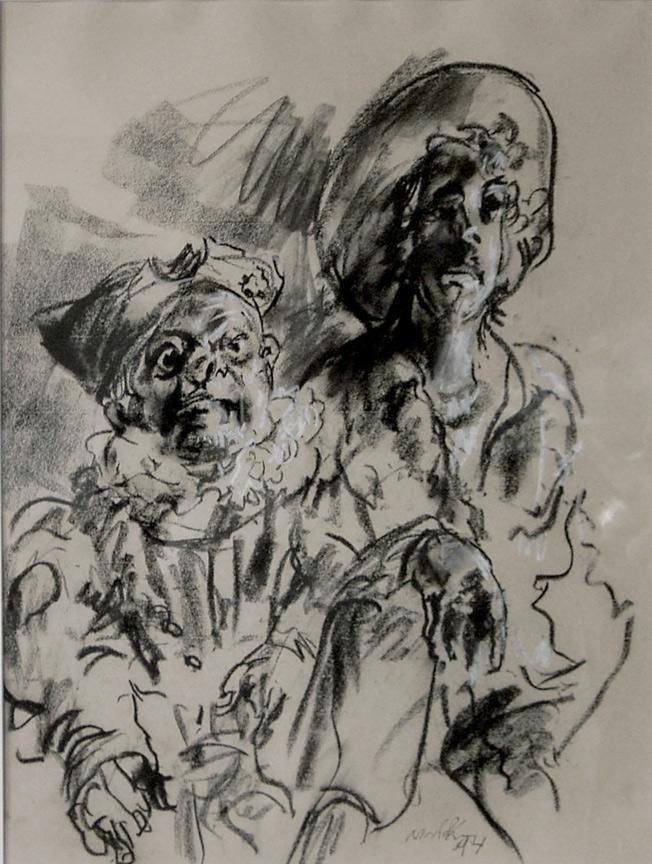
Think about what charcoal does in a drawing versus what ink does. In a way, you can let materials show you the nature of something. But you have to relinquish a certain amount of willfulness on your part to allow it to be, and a lot of that comes in the way that you look at an image. It’s like a triple response. You respond first when you find something you want to do, taking your cues from the dictates of nature. Then you see what happens on the canvas, what the image tells you. And then you have the history that you recognize as your tradition, your past. So you keep going back and forth, between artifice and the genuine response, between spontaneity and the persiflage of old fictive techniques. As Degas said, it takes as much cunning to make a work of art as to perpetrate a crime.
[ad_2]
Source link